


 Blog posts
 Events
 Cloudgov University
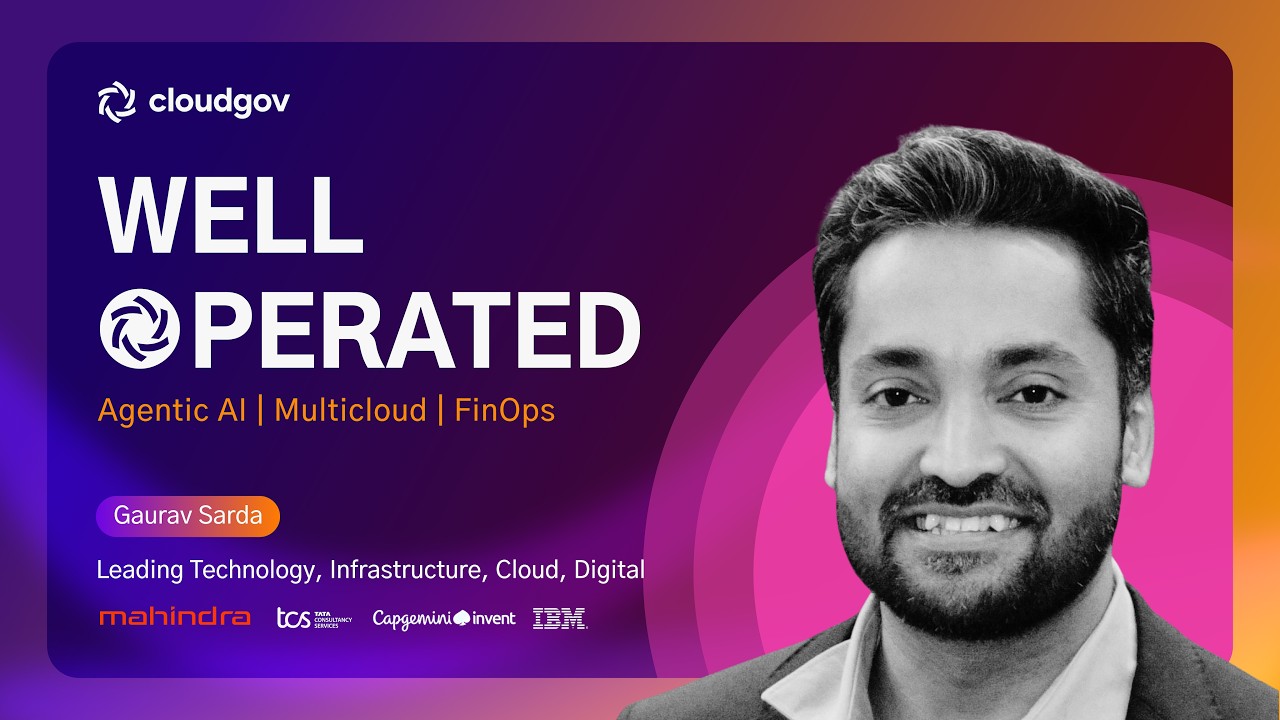
Gaurav Sarda, Head of Technology, Digital, Cloud and AI at the Mahindra Group, joins host Kevin on Well Operated: The Agentic AI FinOps Podcast by Cloudgov.ai. Gaurav breaks down why legacy dashboards fail at enterprise scale, the sudden shift to autonomous agent workflows, how Mahindra uncovered hidden Kubernetes and extended support costs, and his vision for “Invisible FinOps” — cost intelligence embedded directly inside every developer workflow. Connect with Gaurav on LinkedIn.
Full transcript
Chapter 1 — Intro: Leading Cloud and AI at Mahindra Group
Kevin: Hello and welcome back to Well Operated, the podcast where Agentic AI turns FinOps into autonomous action. I am your host Kevin, the human in the loop. Joining me today is Gaurav Sarda, who leads technology, digital, cloud, and Agentic AI at the Mahindra Group. Gaurav is one of the sharpest technology leaders in the space and also happens to be a pioneer using Cloudgov.ai to completely rewrite the enterprise FinOps playbook. Gaurav, welcome to the show.
Gaurav: Thank you. Thank you, Kevin. Happy to be here.
Kevin: Yeah, I’m happy to have you here. Always excited to chat with people at the forefront of this amazing technology. So start by telling us a little bit about your role at Mahindra Group and the scale of your cloud operations and the complexities that you deal with on a day to day basis.
Chapter 2 — Enterprise Scale and Why Legacy Dashboards Fail
Gaurav: Sure. So I lead cloud platform as part of Mahindra Group. I am part of the group technology office of Mahindra Group. We drive enterprise cloud strategy, platform engineering, and FinOps as part of this group. Since it’s a big group, we have a lot of businesses we work with. So necessarily the complexity, the criticality of the workloads is huge, and it’s a good challenge to work with, ensuring that we provide them the scalability, the security, the performance, and at the same time balance it with the costing. So yeah, that’s a good challenge we work with, and my entire team, we work on that.
Kevin: So as your cloud footprint grew, where did the traditional dashboards and native cost explorer capabilities start to feel limiting to you and your team?
Gaurav: So you’re right. When we started working on cloud and we started working on cloud cost visibility, or even budget visibility, the traditional dashboards were not designed for cloud. I mean, you can basically plug in any kind of data into those dashboards and slice and dice the data however you want. So it was not designed for cloud. Cloudgov, when we started using Cloudgov, it gives us exactly what we need right at the first go. And then it also has the ability to deep dive into it. We can get into the details of it, we can question it. Why is something, let’s say if a cloud VM cost is showing a certain amount, why is it so? We can go into the optimization insights and see how do we optimize that cost going forward. So it helps us go into the details, which a traditional dashboard doesn’t allow us to because it’s not meant for cloud.
Kevin: Yeah. Were there other aspects that made you decide to rethink your approach to enterprise FinOps as a whole?
Chapter 3 — Charging Back: Shifting Away from Centralized FinOps Control
Gaurav: Right. So as we are a large group, our goal was for businesses to be able to utilize cloud in the most efficient manner, either from a governance point of view or from cost optimization point of view. We have to work on a lot of chargebacks because it’s a large group. So ensuring all of that wasn’t possible through the traditional ways, and we wanted to work with a system which not only allows us to do all of this but also is futuristic in its thought process and in its design, and has a set of people that we can work very closely with. Cloudgov kind of allowed us to do that. We almost work daily and weekly with them, weekly catchups, and we can call them up at any point in time to understand where we’re going. The priorities are changing so frequently these days in technology that we are able to do that with Cloudgov, and that’s the advantage we get with Cloudgov. As an enterprise, our priorities change more frequently than others, and that’s the benefit we get working with Cloudgov.
Kevin: You mentioned you wanted something futuristic. It sounds funny when you say it that way, but I love it. Are things just moving at such a quick pace that as you’re looking at your enterprise FinOps you have to say, hey, we’ve got to be able to change quickly and we need a company that’s going to make sure that they’re changing quickly too?
Chapter 4 — Switching Gears: The Sudden Evolution to Agentic AI
Gaurav: Actually, they are. When we started working with Cloudgov, that was almost a year back, we were not talking about a lot of agentic autonomous workflows. It was just starting. The conversation was just starting in terms of leveraging ChatGPT or Copilot or many other similar products that we have in the market. It was more about generating content. But then Agentic came into the overall space and we had to switch gears at the same time. By the beginning of this year, when we actually implemented Cloudgov, we were ready with the dashboard and we were ready with all the data points and we could see what are the optimization insights. We had to start working on agentic workflows. We had to start working on how can we optimize costs much faster. We cannot work with what we were already doing, which was already sufficient or good enough at that point in time. But how can we still do it faster? How can we do it autonomously? So when I say futuristic, I look at FinOps in the future…
Chapter 5 — Invisible FinOps and Democratic FinOps
Gaurav: …as invisible. Right, from a business point of view, from a user point of view, it’s as good as it does not exist. It should be that seamless, or it should be that simple that it’s embedded in their entire journey. Let’s say if you take a developer, right from the point when they start architecting their application, they start putting into the code, the nudges or the intelligence we can build into their workflow, and they don’t have to go anywhere and do cost optimization. It’s just part of the journey. It’s just part of the design. So that’s the future I look up to, and that’s the excitement that we work with.
Kevin: Yeah, programs like this you basically just want stuff to work in the background and you don’t need it to be at the foreground. You want it to just work. Yeah, I get that. What do you think great enterprise FinOps takes at Mahindra scale across people, process, and governance?
Gaurav: FinOps cannot be a centralized function. I know that’s part of the key principles of FinOps, that we cannot rely on a central body to drive FinOps. So for us at an enterprise level, this becomes more important. As a large company with a number of application developers, a number of finance folks, a number of all kinds of professionals, how do we make it democratic? How do we make it self service? If I can make FinOps self service, if each and every one of us is doing FinOps sometimes without knowing it, sometimes knowing it, that’s great, because then we are doing FinOps at every point in time, and that’s the best we can do.
Secondly, if I can have FinOps throughout my journey, as I mentioned a while back, right from the design phase, not after deploying an application or deploying a workload on cloud, even before that from the design phase. And once it’s operational, bringing in all the autonomous agents and all the technology to make sure that we are optimizing at that point as well. If we can do it right through the value chain, I think that’s the best we can do. So if we can make it self service, if we can make it throughout the value chain, we’re basically doing FinOps everywhere.
And one more thing that I would like to mention is, it’s not just about the hardware when we say FinOps, although we talk about it from a cloud point of view, but as an enterprise, I want to look at FinOps from every angle, right from hardware to software to licenses. We spend a lot of money on these aspects as well. So FinOps in entirety could be a great way to look at FinOps. When we say great FinOps, probably those are a few other things I could think of.
Kevin: How do you build a culture where cost consciousness lives across every engineering team, and accountability and results are created using Agentic AI?
Gaurav: It’s a tough one. It’s a tough one because everybody has their own interests and motivations and goals. It’s a tough one to get everybody optimizing cost. So with Agentic and with autonomous agents, there’s the power where we don’t have to make somebody do it deliberately. It can be part of their journey. If it could be as seamless as that. Let’s say I’m working on my workflow, I’m just writing code, and while writing code, if I can get a prompt to optimize something that I’m trying to do there. Let’s say I’m spinning up my application and I’m using a certain database or a certain script, if it could tell me what to optimize there, even if it’s a small bit of optimization, the agentic and the autonomous bit of it is helping me do all of that. So I think we are in a time and we are in a space where we could do all of this now, where the culture can be really spread across the company across all the professionals, and we don’t have to do FinOps deliberately.
Kevin: Was there a moment where Cloudgov pleasantly surprised you with an outcome or insight?
Chapter 6 — Uncovering Hidden Kubernetes and Extended Support Costs
Gaurav: Yes. When we started with Cloudgov, we already were at a good maturity in terms of FinOps. We were of course using traditional dashboards and other ways of doing it, but we were doing FinOps and we want to believe at a pretty good level. Topping that and still coming up with insights and optimization opportunities was a big challenge. And I think when we started with Cloudgov, we identified certain insights for optimization. For example, out of version services and the extended support costs for them. We were not doing that earlier. But once we got into Cloudgov, we were able to get those insights and able to optimize some new costs which we never knew about. We are able to look at our Kubernetes costs and optimize them in the same platform. So a lot of new insights were the ones that really surprised us, or you could say made us happy that we are working with the right partner. That is one thing I would call out.
Second thing is the speed and the level at which we can collaborate with Cloudgov. As I mentioned, we had to shift gears when Agentic came into action, when Agentic really took off. We could shift gears with Cloudgov. We could collaborate at the same pace that we are doing on the earlier bits that we were working on. So these are some of the things that we really like working with them, and we continue to work with them.
Kevin: In your view, what’s next? What comes after dashboards? Where is enterprise FinOps heading?
Chapter 7 — Reaching the User: Flipping the Script on Legacy Cost Reporting
Gaurav: So one thing that we are working on, Kevin, is, as I mentioned, I briefly touched upon it, invisible FinOps. I’m just calling it invisible FinOps because it’s in the background. But another thing is that I believe if we could go to the user, rather than the user coming to Cloudgov or my dashboards, then we again help to speed up the journey. Again, a business, a user, and we have to empathize with them because ultimately technology is for the business. So if we reach the business or we reach the user saying that these are the opportunities, rather than the user coming to the dashboard and us asking the user why don’t you go and check out your costs, you see your insights, why don’t you optimize them. We reach to the user. It’s very simple. It’s not a large transformation, but the point is that very simple things I believe can make big differences.
So if we reach to the user and say these are the optimization opportunities, and with Agentic we can let them chat through those opportunities and understand more in detail and take actions. Because ultimately, cost optimization has to be approved by a business, approved by user. We as technology folks cannot take those decisions because ultimately those are business workloads. Those are business applications. So a simple thing like this where we change the approach of reaching to the user, of course enable it through Agentic and autonomous workflows, make it self service, make it completely invisible. I think these are a few of the things that keep us excited.
Kevin: Yeah. I think that sounds great. And as AI takes on the dashboards, the manual FinOps analysis, what’s your message to FinOps professionals about their future?
Chapter 8 — Core Principles: Advice for Future Cloud and Finance Professionals
Gaurav: See, one thing I would like to say is that think like a business or think like a business user. Don’t think first about the technology. Think about the business. Think about the user and think about their journey. Whatever they’re trying to do. If they’re building a product, or they’re working on certain processes, if we could empathize with the business, with the user, and then embed our technology into their workflows, I think that’s the best chance we have to be very closer to doing the best and giving the most efficient cloud costs and efficiently providing cloud to our users. So yeah, I think one message would be that think like a business, think like a user. Of course you will have to learn technology and continuously evolve and continuously upgrade your technology. That is nothing to specifically mention about, but think like business. I think if we can do that, we can do better with technology as well.
Kevin: I mean, it seems like it’s a pretty good career to get in now, just because it’s moving quickly. It’s somewhat young. What advice would you give someone who’s considering starting a FinOps career today?
Gaurav: Someone who wants to start a FinOps career, I would recommend them to first of all understand cloud well, cloud architecture well. Because there is so much to do in FinOps, right from governance to tagging to chargebacks. Optimization itself is a huge area, and there is consistent focus on optimization with AI and Agentic. The governance has to be much stronger. We read reports, I think very frequently, where we see that an organization leaked a lot of money because they didn’t have the controls in place for Agentic or AI. So understand cloud architecture deeply, understand unit economics, again very close to what business does, the per unit cost of doing something. So understand unit economics, of course understand Agentic, think like a business, think like a business user, empathize with them, and if we can do some of these things, I think that’s a great starting point. And of course we evolve as we keep doing this. But these are some of the principles if you could keep in mind, I think we can be great professionals.
Kevin: Yeah, and I think you hit it on the head earlier when you said keep up with the newest technology and make sure you get the newest technology. In a rapidly moving area, things are going to change quickly. So is it just constant education or re education?
Gaurav: It’s like it has to be part of our DNA. Kevin, you know that there’s nothing we can do about it. It’s just changing so fast and it’s exciting. The changes are exciting. Six months back what we were imagining and where we are today, and I don’t know about six months later what else would we be doing. So yeah, we have to be on our toes.
And it’s easy. Information is all over. And the right information is all over. It’s not a big challenge anymore to learn, to know what’s happening. It’s on your fingertips. So I think getting knowledge is a no brainer and it’s very easy. Getting deeper into it is important. Really knowing your domain is very important. And if FinOps is something that we want to do, knowing cloud is very important. So we have to start with the basics. It cannot be directly with Agentic. So knowing cloud is very important, knowing unit economics is important. Add on top of that Agentic, autonomous, and if we can think like a business, again I know I’m iterating, but if we can think like a business and do all of this, I think we’ll be in a great space to serve our business and our customers.
Kevin: You’re right. I always love when people are like, I wonder where AI is going to be in five years. I’m like, five years? How about five months? Who knows. It’s moving so fast. But to your point too, there’s so much knowledge out there. It’s not hard to find stuff anymore. Whether you get your knowledge through reading, video, podcasts, audio, whatever, there’s plenty of ways to be educated out there. So as we finish up here today, Gaurav, what’s the one thing that you’d want every enterprise leader to take away from our conversation today?
Gaurav: I know that we are all trying to work on Agentic and enterprise right now. That’s the hot topic. And there’s clear benefits and value attached to it. Whatever we do, we should attach it to a business problem. And it’s tough getting it to work. It’s very powerful, but it’s tough getting it to work. So the definition of what we want to do and what we want to achieve with a particular use case, if it’s FinOps or any other use case in cloud or outside cloud as well, the definition has to be very clear. What we want to do, what we want to achieve. And building a team and working on it is going to take time. It’s going to take time. But we ultimately are going to realize that value. The only message from me to my peers and my leaders would be that we need to define it very clearly and we just keep working on it. Because the technology is very powerful, but we need to just make sure that we have it clearly defined. The clarity needs to be there when we do it. Yeah. I think that would be the message.
Kevin: I like that. Clarity. I like that. I think that’s really important. And if you can get that, you’re ahead of the game, right?
Gaurav: Probably. Yes.
Kevin: All right, Gaurav. Well, thank you so much for joining me today. Gaurav Sarda from Mahindra Group. Really appreciate your time. Thanks for all the insight.
Chapter 9 — Outro: Keeping Your Enterprise Well Operated
Gaurav: Thank you, Kevin. Thanks for your time as well.
Kevin: And thank you all for joining us today. If today’s conversation got you thinking about how to make your FinOps truly self driving, check out Cloudgov.ai, where Agentic AI turns cloud cost management into autonomous action. Especially if you’re tired of legacy vendors that overpromise and underdeliver. It’s time to move to a platform that actually evolves with you. Visit Cloudgov.ai and experience how consistent innovation and AI powered automation keep everything Well Operated.