


 Blog posts
 Events
 Cloudgov University
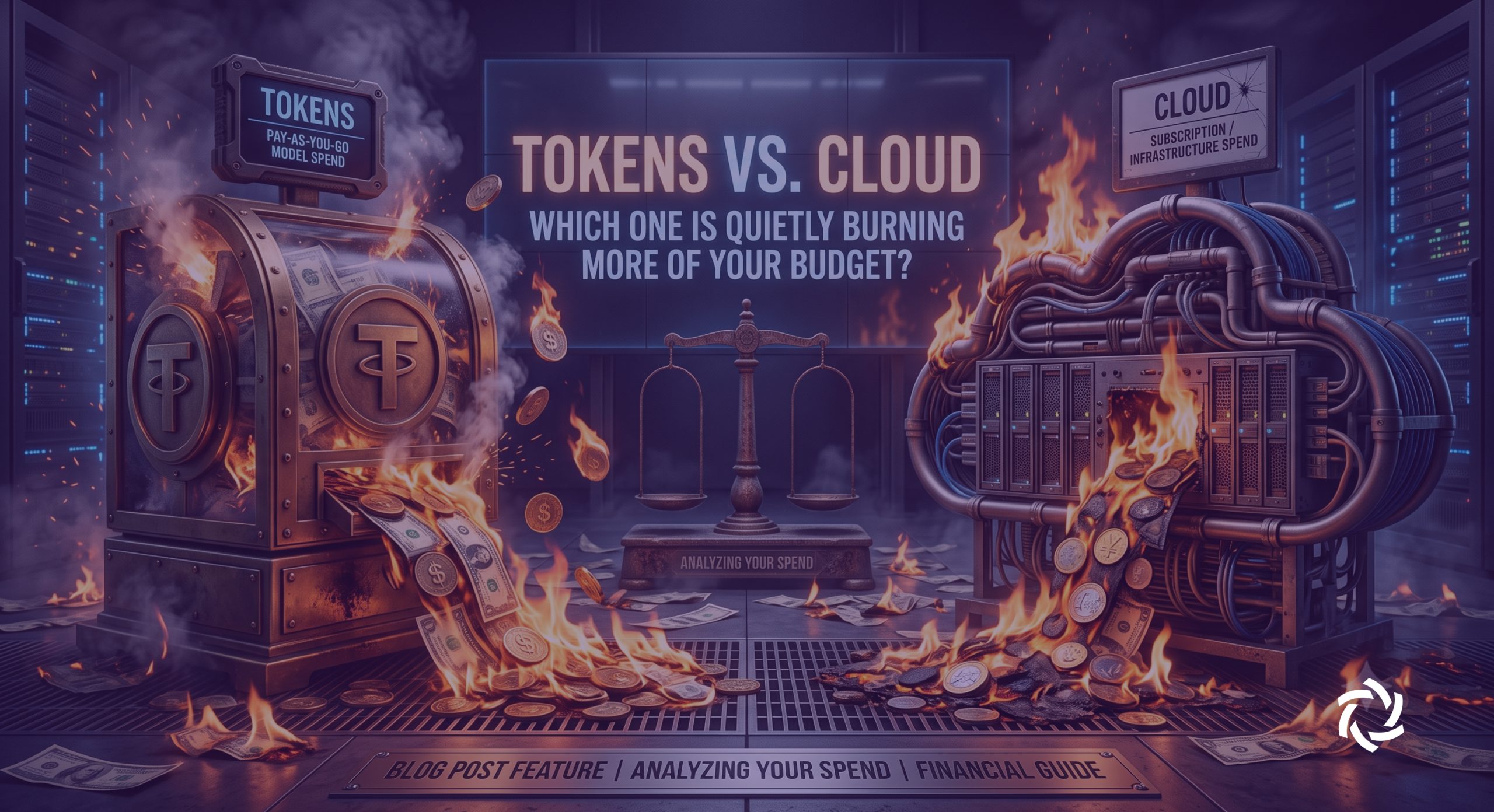
Your finance team just flagged a 40% spike in “software subscriptions” last quarter. When you dig in, you find OpenAI API calls buried in a marketing automation platform, Claude tokens consumed by sales enablement tools, and Azure OpenAI instances spinning up inside a customer service workflow that no one in engineering even knew existed. Meanwhile, your AWS and Azure cloud bills have been flat for six months.
Here’s the uncomfortable reality: the question isn’t whether tokens or cloud is burning more budget. It’s which one you can actually see — and which one is growing in the dark, consumed by teams who’ve never thought about unit economics.
The answer matters because AI spend is replaying cloud’s decade-long waste lesson, but compressed into 18 months and distributed across every department. If you don’t act now, you’ll spend the next three years playing the same cleanup game FinOps teams are still fighting with cloud infrastructure.
The Cloud Waste Problem: Big, But Bounded
Let’s start with what we know. The Flexera 2025 State of the Cloud Report estimates that 27% of cloud spend is wasted — a figure that’s remained stubbornly consistent for three consecutive years. At Gartner’s projected $675 billion global cloud infrastructure market, that represents approximately $182 billion in annual waste globally.
For an enterprise spending $10 million annually across AWS, Azure, and GCP, that’s $2.7 million going nowhere. Idle compute instances. Unattached storage volumes. Oversized databases running at 15% utilization. Development environments that hum along 168 hours per week when engineers touch them maybe 40-50 hours.
What Makes Cloud Waste Governable
But here’s what the headlines miss: cloud waste was always a contained problem.
The infrastructure team owned the AWS account. Platform engineering managed the Azure subscriptions. A handful of SREs spun up GCP projects. The consumer and the administrator were often the same person — or at least sat in the same Slack channel. When costs spiked, you knew exactly whose pager went off.
This ownership clarity enabled the entire FinOps industry to emerge:
The FinOps Foundation’s State of FinOps 2024 report found that 74% of enterprises now have dedicated FinOps teams or practitioners. That’s a ten-year journey from ad-hoc script cleanup to structured practice with showback, chargeback, and commitment optimization.
Cloud waste is real, expensive, and deserves attention. But it has a perimeter. You can draw a circle around it, assign owners, and build guardrails.
The Token Waste Problem: Distributed and Invisible
Now consider where AI/token spend is heading.
Gartner forecasts global Generative AI spending will reach $644 billion in 2025 — a 76.4% increase from $365 billion in 2024. More striking: the growth rate is accelerating, not decelerating. Hardware (AI servers, accelerators, devices) accounts for roughly 80% of that spend, but the software and services layer — the API tokens, the model inference costs, the SaaS subscriptions with embedded AI — is where governance breaks down completely.
The Decentralization Problem
Unlike cloud, AI consumption has no perimeter. The marketing team signs up for ChatGPT Enterprise without asking IT. Customer support builds thin wrappers around Claude for ticket routing. Sales imports prospect lists into an AI-powered enrichment tool that quietly burns tokens matching LinkedIn profiles. Legal uses contract analysis software that runs document comparisons against an LLM backend.
Every department is now a consumer. Almost none of them understand what a token costs.
McKinsey’s State of AI 2025 Global Survey found that 88% of organizations are now using AI in some form, but only 23% have deployed AI systems at enterprise scale. The gap between consumption and governance is where waste lives.
What Token Waste Actually Looks Like
Consider the math. An enterprise-grade LLM API charges roughly $10-15 per million input tokens and $30-60 per million output tokens. That sounds cheap until you run the numbers on actual usage:
- Marketing automation: A campaign personalization workflow consuming 50 million tokens monthly across a 100K prospect list = $2,000-4,000/month in pure token costs, often invisible inside a $15,000/month platform license.
- Customer support: AI ticket classification routing 500,000 tickets monthly through an LLM for sentiment analysis and categorization = 25-50 million tokens = $1,500-3,000/month hidden in “platform fees.”
- Sales enablement: CRM-integrated AI writing assistant used by 200 reps generating 10 email drafts daily = 40,000 queries × 2,000 tokens average = 80 million tokens/month = $4,000-8,000/month.
Individually, each workflow seems manageable. Collectively, across marketing, sales, support, HR, legal, and product teams, you’re looking at $50,000-200,000 monthly in token costs that no single dashboard surfaces.
And unlike cloud, where you can query:
aws ce get-cost-and-usage
  --time-period Start=2025-01-01,End=2025-01-31
  --granularity DAILY
  --metrics "UnblendedCost"
  --group-by Type=DIMENSION,Key=SERVICE
Or Azure:
az consumption usage list
  --start-date 2025-01-01
  --end-date 2025-01-31
  --query "[].{Date:instanceName, Cost:pretaxCost, Service:meterDetails.meterName}"
Or GCP via BigQuery billing export:
SELECT
  service.description AS service,
  SUM(cost) AS total_cost,
  SUM(usage.amount) AS usage_amount
FROM `project.dataset.gcp_billing_export_v1_XXXX`
WHERE usage_start_time >= '2025-01-01'
  AND usage_start_time < '2025-02-01'
GROUP BY service
ORDER BY total_cost DESC
There’s no unified API for token consumption. OpenAI’s usage dashboard shows you API calls. Anthropic’s console shows Claude usage. Your SaaS vendor’s invoice shows a flat seat license. The fragmentation is the point.
Why Distributed Waste Is More Dangerous Than Centralized Waste
The cloud industry spent a decade learning that unsupervised consumption becomes uncontrolled cost. FinOps emerged as a discipline specifically because engineers treated cloud resources as infinite and free — until finance received the bill.
AI is repeating that lesson, but with three accelerants that make it more dangerous:
1. Consumption Velocity
Cloud infrastructure provisioning still requires technical knowledge. You need to understand instance types, regions, networking. There’s a gate, even if it’s a low one.
AI consumption has no gate. Anyone who can use a chat interface can consume tokens. Anyone who can approve a SaaS purchase can embed AI into a workflow. The time from “I want to try this” to “we’re spending $50K/month on tokens” is measured in weeks, not quarters.
2. Organizational Invisibility
When an EC2 instance runs idle, CloudWatch metrics show 5% CPU utilization. When a storage volume is unattached, AWS Cost Explorer flags it under “unused resources.”
When a marketing team burns tokens on a personalization workflow, no system alerts you. The LLM provider sees high usage and celebrates engagement. The SaaS vendor bundles token costs into platform fees and sends a single invoice. Your finance team sees “SaaS subscription: $25,000” and approves it.
Shadow AI — the AI equivalent of shadow IT — is already pervasive, but without the triggers that made shadow IT visible. When a department spun up an unauthorized AWS account, the cloud bill exposed it. When a department embeds AI into their workflow, the consumption is invisible inside legitimate seat licenses.
3. Absence of Accountability Structures
FinOps works because there’s a feedback loop: engineering consumes, FinOps measures, engineering adjusts. The people spending the money see the impact of their decisions.
AI consumption breaks that loop. The marketing manager approving an AI-powered campaign tool doesn’t see token costs — they see a subscription fee. The sales director adopting an AI writing assistant doesn’t receive a chargeback report showing $8,000/month in inference costs. The contract lawyer running document analysis has no idea that their “AI enhancement” is consuming more tokens than your entire engineering team’s Copilot usage.
McKinsey’s research directly correlates AI governance maturity with bottom-line impact. Organizations where CEO-level oversight governs AI deployment show significantly higher self-reported returns from AI investments. The governance gap isn’t a future problem — it’s a current differentiator between AI investments that generate value and AI consumption that generates noise.
Both Burn Money. Only One Is Manageable With Current Tooling.
This isn’t an argument to deprioritize cloud cost optimization. At 27% waste, your AWS, Azure, and GCP environments still contain multimillion-dollar savings opportunities that mature FinOps practices can capture:
The tools exist. The processes are documented. The FinOps Foundation has published frameworks, the cloud providers have built native tooling, and third-party platforms (including Cloudgov.ai) have automated what used to require tribal knowledge and manual script maintenance.
AI/token spend doesn’t yet have that infrastructure. Native tools don’t exist because the providers have no incentive to help you consume less. Third-party governance platforms are nascent. Internal accountability structures haven’t been built.
That’s exactly why AI waste will outpace cloud waste in damage if you don’t act preemptively.
The Governance Gap: Organizational, Not Just Technical
The most common response to AI spend concerns is “we need better tools to track token usage.” Tools are necessary but insufficient. The real gap is organizational.
What Cloud Governance Taught Us
FinOps succeeded because it aligned three elements:
- Financial accountability: Showback reports that showed engineering teams what their consumption cost
- Technical ownership: Engineers who could act on the data — right-sizing instances, scheduling downtime, purchasing commitments
- Executive sponsorship: CTO/CIO mandate that cost efficiency was a priority, not an afterthought
Without these three elements, tools become shelfware. AWS Cost Explorer existed for years before most enterprises used it effectively. Azure Cost Management has powerful features that most organizations ignore. The tooling wasn’t the bottleneck — organizational maturity was.
What AI Governance Requires
AI spend demands the same trinity, but with harder alignment challenges:
The organizational design problem is harder because AI consumption doesn’t map to existing cost centers. Cloud spend aligned with IT budgets. AI spend aligns with departmental SaaS budgets, centralized procurement, and shadow purchasing that bypasses IT entirely.
A Unified Governance Model: The Only Scalable Approach
The mistake most enterprises are making right now is treating cloud FinOps and AI spend governance as separate initiatives. They’re not.
Both are consumption-based cost centers with similar waste patterns: over-provisioning, lack of visibility, misaligned incentives between consumers and payers. Both require measurement, attribution, optimization, and accountability.
The right model treats both under a unified governance layer:
Unified Visibility
A single dashboard that shows:
- Cloud infrastructure spend by service, region, team
- AI/token spend by provider, workflow, department
- Combined cost trend and anomaly alerting
Without unified visibility, you’ll optimize 15% savings on the cloud bill while AI spend grows 76% annually in the background.
Unified Attribution
Showback and chargeback models that attribute:
- Cloud consumption to engineering teams (existing FinOps practice)
- AI/token consumption to consuming departments (new capability requiring SaaS contract renegotiation and usage reporting)
The economics team using an AI-powered analytics platform should see what their token consumption costs — just as the engineering team sees their EC2 spend. This is where automated showback and chargeback attribution becomes essential.
Unified Optimization
Agentic systems that can:
- Schedule non-production cloud instances to off-hours (60-70% savings on dev/test)
- Flag token-inefficient prompts or workflows for review
- Recommend reserved capacity for predictable AI workloads (yes, the same concept as Reserved Instances applies to token commitments)
- Detect anomalous consumption patterns across both domains
This is where platforms like Cloudgov.ai demonstrate value: providing a single governance layer with autonomous multicloud cost optimization that applies FinOps principles (measurement, attribution, optimization) across both cloud infrastructure and AI/token consumption.
Unified Accountability
Executive-level ownership that:
- Includes AI spend in quarterly cloud/technology financial reviews
- Assigns departmental budget responsibility for AI consumption
- Establishes governance policies before scale, not after waste accelerates
McKinsey’s data is unambiguous: organizations with CEO-level AI governance oversight show measurably higher returns from AI investments. The governance isn’t overhead — it’s the mechanism that converts AI spending into AI value.
Multicloud Complexity Meets Multi-Department Complexity
Enterprises managing $10M+ in annual cloud spend already understand the fragmentation challenge: AWS Cost Explorer shows one view, Azure Cost Management another, GCP Billing a third. Normalizing across providers requires FOCUS schema adoption or significant custom integration.
AI/token spend adds a second dimension of fragmentation: not just multiple providers (OpenAI, Anthropic, Google, AWS Bedrock, Azure OpenAI), but multiple consuming departments (marketing, sales, support, legal, HR, finance) each with their own procurement channels, usage patterns, and visibility gaps.
The product of these two dimensions — multicloud × multi-department — creates a governance matrix that manual processes cannot address. Each major cloud provider offers 250+ services with 20+ cost-impacting configurations each. That’s 5,000+ optimization opportunities per cloud. Across three clouds, that’s 15,000+ potential cost decisions.
Now multiply that by the number of departments consuming AI tokens, each with multiple SaaS integrations, each with different billing structures and usage visibility.
The only feasible approach is automation. Agentic AI systems that can autonomously monitor, attribute, and optimize across both dimensions — without requiring your team to manually review 15,000+ cloud configuration decisions and uncountable token consumption points.
Role-Based Perspectives: What This Means For You
For the Head of Cloud Platforms
You’ve spent three years building FinOps maturity. Your cloud waste is down from 35% to 27%. You have showback reports, commitment coverage dashboards, and anomaly alerting.
Don’t let AI spend become a parallel ungoverned budget that erodes your efficiency narrative. Finance is already asking why “software subscriptions” grew 40% last quarter while cloud held flat. Those line items contain the consumption patterns you should be governing — under the same platform you use for cloud.
Action: Expand your scope to include AI/token spend. Talk to your procurement, legal, and marketing counterparts about where they’re embedding AI. Build a unified view before AI waste compounds into a separate crisis.
For the FinOps Director/Manager
Your practice is mature enough to handle this. The FinOps Foundation framework (Inform, Optimize, Operate) applies perfectly to AI spend. The challenge isn’t technical skill — it’s expanding the stakeholder map.
Cloud FinOps engaged engineering leadership. AI FinOps needs to engage sales operations, marketing operations, legal operations, and every department head whose teams are consuming AI embedded in their tools.
Action: Audit your organization’s AI consumption. Start with SaaS contracts — which platforms include AI features? Which teams are using them? Build a preliminary consumption map, then create chargeback models that attribute token costs to consuming departments.
For the CFO
You’re the only executive who sees both line items: cloud infrastructure and software subscriptions. Your finance team is asking why both are growing. Your CIO says cloud is under control. Your CMO says the new marketing platform is essential.
The reconcile: AI/token spend hidden inside SaaS subscriptions is the growth driver you’re not governing. Unlike cloud, which IT can optimize, AI consumption is happening in departments that have never been asked to think about unit costs. Use FinOps Score benchmarking across cloud and AI consumption to establish a maturity baseline.
Action: Mandate AI spend attribution. Require every SaaS contract renewal to include usage reporting for embedded AI features. Create departmental P&L accountability for AI consumption, not just seat licenses.
For the CIO/VP Infrastructure
You already own the cloud bill. You’re being asked to own security, compliance, and governance for AI as well. The worst mistake you could make is treating AI as “someone else’s problem” until it becomes an incident.
Shadow AI is already deployed across your organization. Marketing is pasting proprietary data into external LLM interfaces. Sales is uploading customer lists to enrichment platforms. Legal is running confidential contracts through AI analysis tools you’ve never reviewed.
Action: Conduct an AI consumption audit. Not just “what AI tools are we using?” but “what data is flowing through them and who pays for the tokens?” Establish procurement guardrails that require IT/security review before AI tool adoption.
Key Takeaways
- Cloud waste is 27% of spend but bounded within engineering — governable with mature FinOps tooling.
- AI/token spending is growing 76% annually with no organizational owner — distributed across every department.
- Shadow AI parallels shadow IT but lacks the visibility triggers that made shadow IT discoverable.
- Unit economics literacy doesn’t exist outside engineering — marketing, sales, HR consume tokens without cost awareness.
- Unified governance across cloud and AI is the only scalable approach — the same accountability loop must apply.
Stop Playing Whack-a-Mole. Start Governing Proactively.
Here’s what we’ve seen at Cloudgov.ai: enterprises that apply governance before AI scale are catching waste in weeks. Those that wait for the CFO to flag “software subscriptions” growing 40% are already three quarters behind.
Within 48 hours of connecting multicloud environments to a unified governance platform, organizations typically surface $50K-200K monthly in invisible AI spend — tokens consumed by workflows no one realized were billable, departments using AI-enhanced tools without usage attribution, and duplicate integrations across teams.
Cloudgov.ai provides the unified governance layer that applies FinOps principles across both cloud infrastructure and AI/token consumption. Automated showback/chargeback attributes costs to consuming departments. Anomaly detection surfaces token spikes before they compound. Agentic optimization identifies waste patterns that manual review cannot.
With 20-minute onboarding and SOC 2 Type II compliance, you can have visibility into both dimensions of spend within days — not the 3-6 month implementation cycles of legacy FinOps tools.
The organizations that learn from cloud’s decade-long governance lesson — and apply it to AI proactively — will be the ones converting AI spending into AI value. Everyone else will be playing catch-up for the next five years.
Start your 2-week free Proof of Value today at cloudgov.ai
OR contact our team for a personalized walkthrough

SOC 2 Type II | ISO 27001 | GDPR Compliant
Frequently Asked Questions
What percentage of enterprise cloud spend is wasted?
According to the Flexera 2025 State of the Cloud Report, 27% of cloud spend is wasted—approximately $182 billion globally based on Gartner’s $675 billion cloud infrastructure market projection. This figure has remained consistent for three consecutive years, indicating persistent governance gaps despite mature FinOps tooling.
How fast is enterprise generative AI spending growing?
Gartner forecasts global generative AI spending will reach $644 billion in 2025, a 76.4% increase from $365 billion in 2024. This growth rate significantly exceeds cloud spending growth and is accelerating rather than decelerating, making governance a critical priority before scale compounds waste.
Why is AI token spend harder to govern than cloud spend?
AI token spend is consumed across every department (marketing, sales, HR, legal, support) rather than centralized in engineering. These consumers lack unit economics literacy—they don’t know what tokens cost. Additionally, token costs are often hidden inside SaaS subscription invoices with no separate usage reporting, making traditional FinOps visibility tools ineffective.
What is shadow AI and how does it differ from shadow IT?
Shadow AI is the unauthorized deployment of AI tools and workflows across an organization—parallel to shadow IT—but without the visibility triggers that made shadow IT discoverable. When a department spun up an unapproved AWS account, the cloud bill exposed it. When a department embeds AI into workflows, the token costs are hidden inside legitimate SaaS seat licenses, making detection far more difficult.
How do you implement chargeback for AI token consumption?
Implementing AI token chargeback requires: (1) auditing all SaaS contracts for embedded AI features and usage reporting capabilities, (2) negotiating vendor agreements that provide token consumption by department, (3) creating internal cost centers that attribute AI spend to consuming teams, and (4) educating non-technical departments on prompt efficiency and token cost implications. Unified governance platforms like Cloudgov.ai automate this attribution across distributed consumption.
What governance frameworks work for both cloud and AI spend?
The FinOps Foundation framework (Inform, Optimize, Operate) applies to both domains. Key elements include: unified visibility dashboards showing both cloud infrastructure and AI/token consumption, showback/chargeback attribution to consuming teams, anomaly detection for unexpected spending patterns, executive-level ownership that spans CIO (cloud) and CFO (AI-in-SaaS), and agentic automation capable of autonomous optimization across 15,000+ cost decision points.
Should enterprises manage cloud and AI spend under one platform?
Yes. Both are consumption-based cost centers with similar waste patterns: over-provisioning, lack of visibility, and misaligned incentives. Managing them separately creates fragmented governance, duplicate tooling costs, and competing optimization efforts. A unified platform like Cloudgov.ai provides single-pane visibility, consistent attribution models, and agentic automation that optimizes across both domains simultaneously—preventing the scenario where cloud optimization saves 15% while AI spend grows 76% unchecked.