


 Blog posts
 Events
 Cloudgov University

Why Design Isn’t Enough
Every cloud journey starts with ambition. Enterprises migrate workloads, modernize applications, and follow the AWS Well-Architected Framework to design secure, reliable, and cost-optimized environments. Some even join the AWS Migration Acceleration Program (MAP), investing millions to ensure their migration is by the book.
But by year three, reality often looks different:
• 650+ services across AWS, Azure, and GCP
• 200+ configuration knobs per service
• $44.5 billion in global cloud waste annually
• Well-architected designs that slowly degrade into operational chaos
A Fortune 500 CTO told me recently:
“We followed Well-Architected across our entire portfolio with AWS MAP. Two years later, we’re still hemorrhaging 20% of our spend. The frameworks are solid, but our execution is broken.”
This disconnect between design excellence (Well-Architected) and operational success (Well-Operated) is the defining FinOps challenge of 2025. The missing link? Agentic AI.
The Frameworks of Cloud Cost Governance
1. AWS Well-Architected Framework
Guides customers across six pillars:
• Operational Excellence
• Security
• Reliability
• Performance Efficiency
• Cost Optimization
• Sustainability
Within the Cost Optimization Pillar, AWS recommends:
• Implementing Cloud Financial Management (CFM)
• Adopting consumption models (pay for what you use)
• Measuring unit economics (cost per transaction, per customer)
• Attributing costs through tagging and cost categories
• Continuous optimization over time
2. AWS Cloud Adoption Framework (CAF)
Takes a broader view, focusing on business, people, process, and technology. CAF highlights anti-patterns
such as:
• Premature commitments — buying large Savings Plans/Reserved Instances before right-sizing workloads → leading to overcommitment.
3. Philosophy of Governance
FinOps is not a one-time optimization. It’s a continuous, iterative practice:
• Switch from reactive firefighting to proactive governance
• Build repeatable processes to avoid performing the same cleanup every quarter
Foundations of Sustainable FinOps Governance
1. People and Structure
FinOps succeeds when it’s cross-functional. Include: engineering, finance, project managers, and executive sponsors.
• Centralized model: one FinOps team (best for small companies)
• Decentralized model: each BU optimizes independently (medium companies, but maturity varies)
• Federated model: a central FinOps Center of Excellence sets policies, BU champions execute locally (large enterprises)
• Anti-pattern: Siloed efforts – Cloud cost governance thrives on broad participation, not isolation.
2. Process and Education
• Cadence: monthly or quarterly FinOps committee meetings
• KPIs: tagging coverage, non-prod idle savings, forecast accuracy, anomaly MTTR
• Education: AWS Well-Architected reviews, free Skill Builder courses, Cloud Financial Management (CFM) training, gamification & incentives
Two approaches:
• Educate & Allow: invest in training, trust engineers
• Restrict & Review: enforce strict guardrails with quick unblock paths
3. Tools & Controls
• Preventive controls: SCPs (e.g., block GP2 EBS or non-Graviton RDS)
• Detective controls: AWS Config for compliance drift
• Corrective controls: Anomaly Detection + budgets
Automation extends this with:
• Auto stop/start for idle non-prod workloads
• Rightsizing via Compute Optimizer + Step Functions
• IaC Analyzer to validate infrastructure templates against Well-Architected rules before deployment
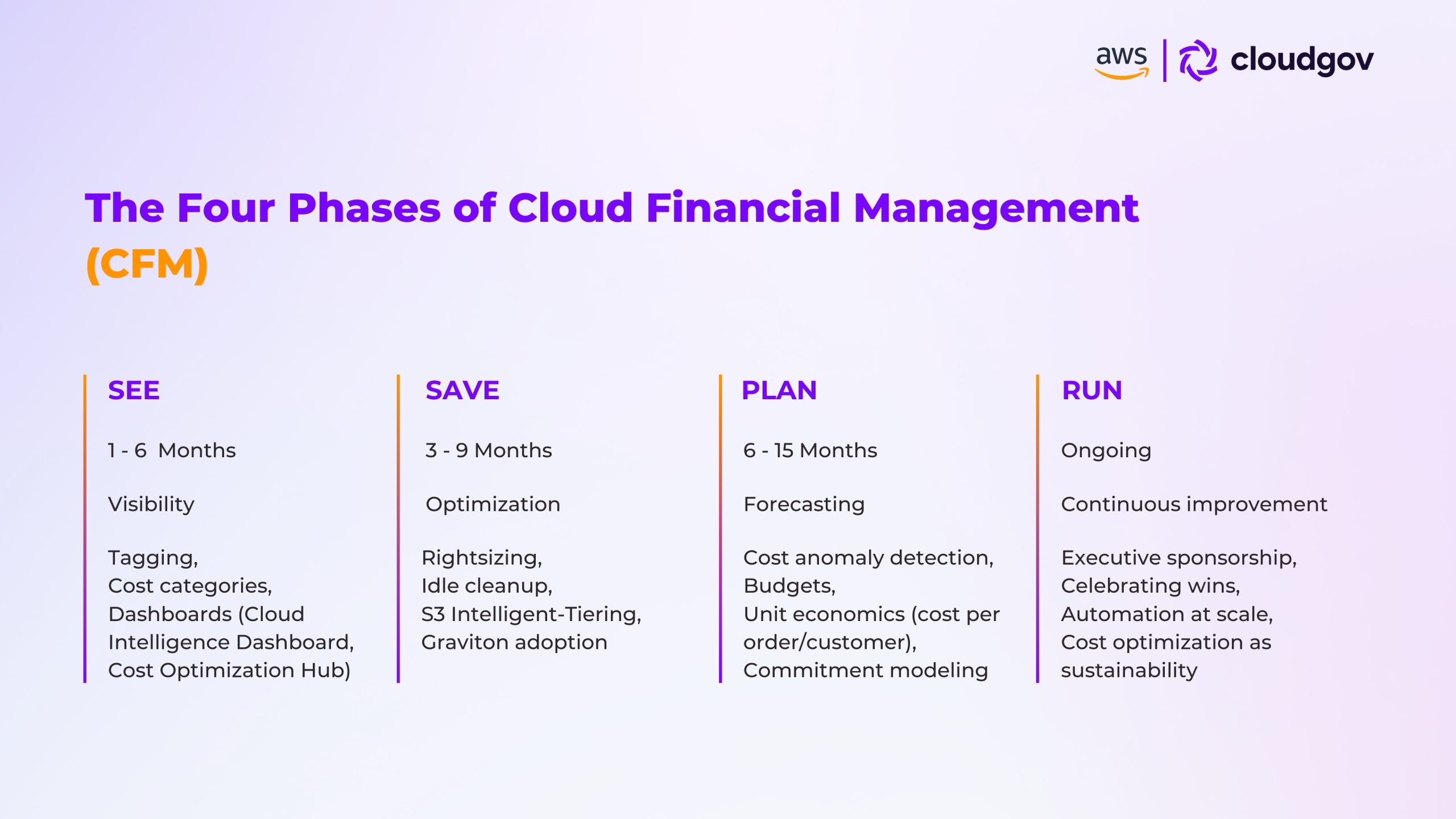
The Four Phases of Cloud Financial Management (CFM)
Why Human-Only FinOps Fails
• Scale problem: 650+ services × 200+ knobs = 130,000+ decisions daily
• Waste: 25–35% of cloud spend is misallocated
• Forecasting: manual Excel models = ±20–30% variance
• Commitments: underutilized or overcommitted SPs/RIs
• Engineer fatigue: repetitive rightsizing and cleanup tasks
Manual FinOps cannot scale.
Cloudgov.ai Agentic AI: Turning Principles into Practice
Cloudgov.ai’s Agentic AI bridges Well-Architected design and Well-Operated reality by continuously executing best practices:
Automation at Scale
• Non-Prod Scheduling: Auto stop/start → 40–60% cost savings in dev/test
• Rightsizing & Storage Optimization: GP2→GP3, S3→Intelligent-Tiering, DB resizing
• Commitment Optimization: Simulate demand before buying SPs/RIs; maintain 90%+ utilization
Governance & Visibility
• Tagging Enforcement: >95% tagging coverage for clean cost allocation
• Showback & Chargeback: role-based dashboards → accountability across BUs
• FinOps Score Benchmarking: maturity, efficiency, effectiveness (0–100 scale)
Forecasting & Anomaly Detection
• Forecast spend within ±5% variance
• Real-time anomaly alerts for runaway queries, sudden egress, or storage spikes
Role-Based AI Assistant
• ChatGPT-style conversational interface
• Tailored to engineers, finance, or product leaders
• Democratizes FinOps knowledge → every user becomes cost-aware
Risk vs Reward

The Cultural Shift: From Awareness to Accountability
Agentic AI doesn’t just optimize—it changes behavior:
- Showback dashboards → transparency
- Chargeback models → accountability
- Leaderboards + gamification → motivation
- Executive sponsorship → reinforcement
Cost optimization becomes part of the daily operating fabric, not a quarterly initiative.
Conclusion
The gap between Well-Architected and Well-Operated defines enterprise cloud management today. Following AWS MAP and Well-Architected principles will get you started—but without automation, you’ll leak 20–30% of your spend.
Cloudgov.ai’s Agentic AI is the bridge. It makes cloud cost governance continuous, proactive, and effective—across AWS, Azure, and GCP.
Request a demo to see your See → Save → Plan → Run maturity roadmap.