


 Blog posts
 Events
 Cloudgov University

Introduction
In today’s digital economy, controlling your cloud infrastructure cost is no longer an operational best practice — it is a business imperative. As companies scale and prepare for fundraising, acquisition, or IPO milestones, the pressure from CXOs to improve financial efficiency is relentless. Cloud Cost of Goods Sold (COGS) has quietly moved from the back office to the boardroom. Now, it’s front and center in every strategic discussion.
For heads of infrastructure, DevOps leaders, and platform engineers, this pressure translates into a clear and urgent challenge: lower cloud COGS without compromising service reliability.
And it’s not getting easier.
Today, lowering COGS isn’t just about keeping operations lean — it’s directly tied to how investors and acquirers perceive enterprise value. Financial efficiency, especially in cloud-first businesses, has become a material lever for improving EBITDA margins, capital efficiency ratios, and ultimately, valuation multiples.
In fact, in private equity and venture capital circles, “cloud spend discipline” has quickly evolved from a nice-to-have to a pre-due-diligence filtering question — right alongside revenue growth and churn metrics.
As one investor quipped recently, “We don’t mind you spending on cloud. We just mind you setting it on fire.”
The COGS Squeeze: Why Infrastructure Teams Are Feeling the Heat
As organizations grow, their cloud usage naturally becomes more complex. Infrastructure that was once manageable evolves into a sprawling network of virtual machines, storage buckets, Kubernetes clusters, managed databases, and SaaS integrations across AWS, Azure, GCP, and Snowflake.
Meanwhile, CXOs and CFOs are demanding:
- Better gross margins
- Lower cost of revenue ratios
- Leaner cloud operating expenses
The problem? Most cloud environments were never architected for cost optimization. They were built for speed, agility, and customer onboarding — not financial discipline.
What’s worse, once cloud costs become “noticeable” to leadership, it’s already very difficult for technical teams to quickly “trim the fat” without risking system stability or service level agreements (SLAs).
FinOps frameworks have emerged to bridge this gap, but simply having a “FinOps Committee” without operationalizing daily action is like appointing a Chief Diet Officer for your company cafeteria — yet still offering free unlimited donuts.
Industry Benchmarks: Cloud Cost as % of Revenue
The heat is even more understandable when you look at financial benchmarks:
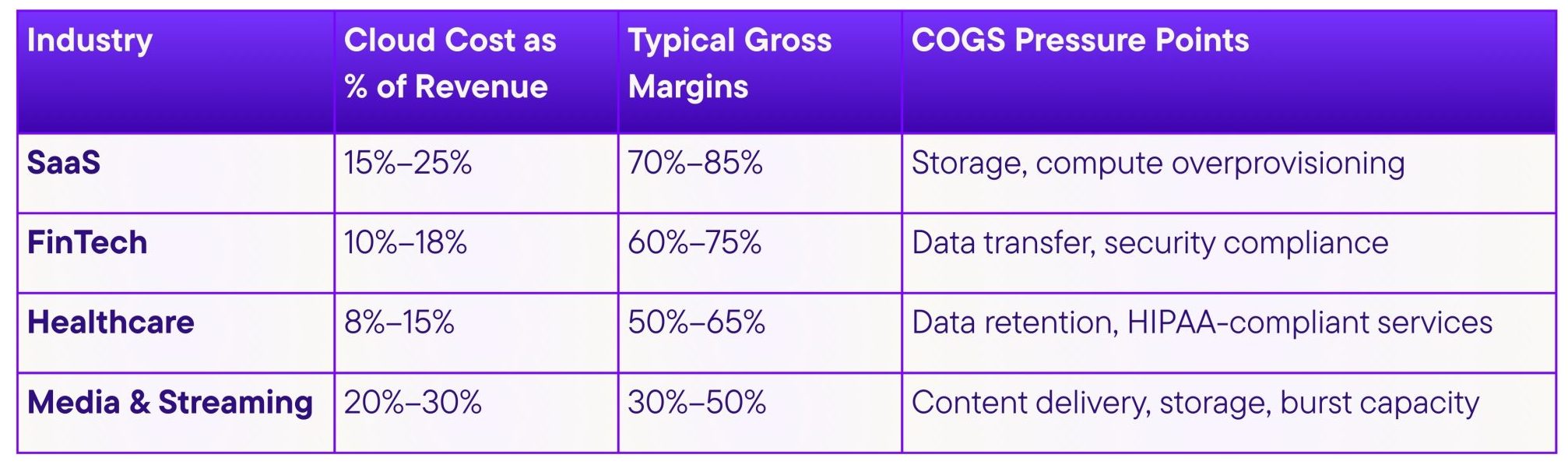
Translation:
- If you’re a SaaS or Media company and cloud costs creep over 25% of revenue, congratulations — you’ve unofficially joined the “We Bleed Cash to Cloud” club (membership has grown sharply post-2022).
- For FinTech and Healthcare, compliance adds to the party, ensuring you pay even more for the privilege of storing customer PII legally.
In boardrooms today, it’s not uncommon for CFOs to ask technical leaders point-blank:
“Is this architecture helping us reach 80% margins, or is it just helping AWS reach theirs?”
The Delicate Balancing Act
Heads of DevOps and Cloud must now walk a tightrope:
- Reduce costs aggressively
- Maintain performance and reliability
- Honor customer contractual obligations (single-tenant, uptime SLAs, data isolation)
- Prepare for scaling and audits (especially with fundraising or acquisition on the horizon)
Simple recommendations like “consolidate workloads” or “move to cheaper regions” often aren’t feasible due to security, compliance, or contractual restrictions.
In short:
“It’s easy to spend investor money on cloud; it’s much harder to optimize it without breaking everything that made your company successful.”
This delicate act has given rise to a new kind of professional hero inside startups:
The Cloud Financial Engineer — part technologist, part economist, part negotiator, and occasional therapist when Reserved Instances go sideways.
The Manual Governance Trap
Many growing companies fall into the trap of trying to manually manage cloud optimization:
- Asking engineers to manually tag resources
- Reviewing bills line-by-line
- Trying to “make sense” of ever-growing SKU pricing catalogs
- Initiating risky Reserved Instance or Savings Plan purchases without predictive intelligence
The reality is that manual cost governance doesn’t scale.
In fast-growing environments:
- Engineers join and leave teams
- Environments drift
- Assets sprawl
- Cloud providers quietly change pricing models (sometimes the same way airlines change ticket prices: mysteriously and aggressively)
Without daily automation and AI-driven insights, even the best teams can’t keep up.
Moreover, manual processes create hidden technical debt.
What starts as an overlooked idle database or an untagged Kubernetes cluster soon snowballs into hundreds of thousands of dollars in avoidable expenses.
In an age where investors look closely at operational leverage, unmanaged cloud spend quietly erodes margin resilience — like a slow leak in a race car tire.
Cloudgov.ai: Your COGS Optimization Partner
At Cloudgov.ai, we’ve lived this reality firsthand. Our platform was built for the modern DevOps leader facing relentless COGS reduction demands.
Here’s how we help you win:
- Daily Drift Detection
- Identify wasted, abandoned, or overprovisioned resources every 24 hours
- Find “silent spend” that manual audits miss
- AI-Powered Recommendations
- Rightsizing compute, storage, and networking based on actual usage
- Intelligent lifecycle management for object storage (S3, Azure Blob, GCP Storage)
- Cost-saving opportunities prioritized by impact
- Predictive Savings Planning
- Smart Reserved Instance and Savings Plan recommendations
- Risk-free modeling before financial commitments
- Tagging Governance and Showback Enablement
- Enforce resource tagging automatically
- Empower chargeback/showback reporting by customer, business unit, or product
- Asset Inventory & Security Visibility
- Multi-cloud asset inventory updated daily
- Identify forgotten infrastructure and security risks
- Executive-Ready Reporting
- Automated reports for leadership
- Slack and Email alerts to keep teams aligned
By empowering engineering and finance teams with real-time insights, Cloudgov.ai turns cloud cost management from an awkward quarterly apology into a consistent competitive advantage.
In a world where investor scrutiny is increasing, and fundraising outcomes depend heavily on margin metrics, cost visibility and control are no longer optional — they are survival strategies.
Final Thought
Reducing cloud COGS is not about random cost cutting. It’s about creating intentional, intelligent, and sustainable efficiencies across your cloud footprint.
Without the right tools, you’re asking your best DevOps minds to dig ditches manually — every single day. That’s undifferentiated heavy lifting your growing company can’t afford.
Companies that proactively operationalize FinOps, automate cloud governance, and make COGS optimization part of their DNA will consistently outpace competitors — not just in margin efficiency, but in valuation, exit outcomes, and resilience during economic cycles.
Cloudgov.ai empowers you to automate cloud cost optimization, without sacrificing speed, scale, or customer experience.
Because when COGS becomes the conversation at the boardroom table, you need to show up with answers — not spreadsheets, not excuses, and definitely not a line item called “Miscellaneous Cloud Oopsies.”